1870 Victorian Ladies Hats Fashion Plate

Bustles and elaborate curtain narrate evening dresses of the early 1870s. The gentleman wears evening dress. Detail of As well Early by James Tissot, 1873
1870s way in European and European-influenced clothing is characterized by a gradual return to a narrow silhouette after the full-skirted fashions of the 1850s and 1860s.
Women'due south fashions [edit]
Overview [edit]


Countess Brownlow in artistic dress, 1879.[i]
By 1870, fullness in the skirt had moved to the rear, where elaborately draped overskirts were held in place past tapes and supported past a bustle. This mode required an underskirt, which was heavily trimmed with pleats, flounces, rouching, and frills. This fashion was short-lived (though the bustle would return again in the mid-1880s), and was succeeded by a tight-fitting silhouette with fullness as low as the knees: the cuirass bodice, a form-fitting, long-waisted, boned bodice that reached beneath the hips, and the princess sheath wearing apparel. Sleeves were very tight fitting. Square necklines were mutual.
Twenty-four hour period dresses had loftier necklines that were either airtight, squared, or V-shaped. Sleeves of morn dresses were narrow throughout the period, with a tendency to flare slightly at the wrist early on on. Women often draped overskirts to produce an apronlike effect from the front.
Evening gowns had low necklines and very curt, off-the-shoulder sleeves, and were worn with short (later mid-length) gloves. Other characteristic fashions included a velvet ribbon tied high around the neck and trailing behind for evening in a like fashion to Georgian era fashion (the origin of the modern choker necklace).
Tea gowns and artistic dress [edit]
Under the influence of the Pre-Raphaelite Brotherhood and other artistic reformers, the "anti-fashion" for Creative wearing apparel with its "medieval" details and uncorseted lines connected through the 1870s. Newly stylish tea gowns, an informal fashion for entertaining at home, combined Pre-Raphaelite influences with the loose sack-dorsum styles of the 18th century.[2]
Leisure Dress [edit]
Leisure dress was becoming an important part of a woman's wardrobe. Seaside dress [3] in England had its own singled-out characteristics but still followed the regular fashions of the day. Seaside wearing apparel was seen every bit more daring, frivolous, eccentric, and brighter. Even though the bustle was extremely cumbersome, it was notwithstanding a part of seaside fashion.
Undergarments [edit]
With the narrower silhouette, accent was placed on the bosom, waist and hips. A corset was used to help mold the trunk to the desired shape. This was accomplished by making the corsets longer than before, and past constructing them from separate shaped pieces of material. To amend back up, corsets were reinforced with many strips of whalebone, cording, or pieces of leather. Steam-molding, patented in 1868, helped hold the curvaceous contour.[4]
Skirts were supported by a hybrid of the bustle and crinoline or hooped petticoat sometimes called a "crinolette". The cage structure was attached around the waist and extended down to the ground, but only extended downwards the back of the wearer'southward legs. The crinolette itself was quickly superseded by the true bustle, which was sufficient for supporting the drapery and train at the dorsum of the skirt.[v]
Hairstyles and headgear [edit]
In keeping with the vertical emphasis, hair was pulled back at the sides and worn in a high knot or cluster of ringlets, frequently with a fringe (bangs) over the brow. False hair was commonly used. Bonnets were smaller to allow for the elaborately piled hairstyles and resembled hats except for their ribbons tied under the mentum. Smallish hats, some with veils, were perched on top of the head, and brimmed straw hats were worn for outdoor habiliment in summer.
Wraps and Overcoats [edit]
The main kind of wrap that dominated in the 1870s were capes and jackets that had a dorsum vent in order to make room for the hurry. Some examples are the pelisse and the paletot coat.[vi]
Style gallery 1870–1874 [edit]
-

1 – 1870
-

2 – 1870
-

-

4 – 1871
-

5 – 1872
-

6 – 1872–73
-

vii – 1874
-

8 – c. 1874
-

9 – c. 1874
-
10 – 1874
-

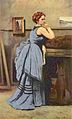
11 – 1874
- Walking apparel of 1870 has a tiered and ruffled skirt dorsum.
- 1870 fashion plate shows jacket-bodices with draped and trimmed skirts in back. Ruffles and pleated frills are characteristic trimmings of the 1870s.
- 1870s American bathing dress, with ankle length skirt, long pants, and long sleeves
- French morning clothes of 1871 features a narrow crimson ribbon at the low neckline and a big matching bow with streamers at the back waist.
- Dolly Varden dresses of 1872 demonstrate the popular manner of the early 1870s known as "Dolly Varden"
- Artistic dress of the early 1870s. Portrait of Mrs. Frances Leyland past Whistler.
- Outdoor dresses of 1874 feature overskirts caught up with buckled ribbons. Jacket-bodices have cuffs and loftier necklines. Small-scale straw hats with flat crowns and long ribbons (like to men's boaters) are worn tipped frontwards.
- Gala dress ca 1874.
- Backview of a dress of 1874 shows the draping of the overskirt and the slight train on the underskirt. French republic.
- Dress of 1874 with draped overskirt and ruffled underskirt.
Mode gallery 1874–1879 [edit]
-
1 – 1874–1876
-

2 – 1875–76
-

three – c. 1875
-

4 – c. 1877
-

5 – 1878
-
6 – 1878
-

seven–1876
-

c. 1878
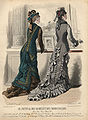
- Tight dresses with long trains of the mid-1870s are trimmed with pleated ruffles, bows, buttons, and braid, and are worn with hats with ribbon streamers.
- French evening gown is festooned with flowers and is worn with mid-length white gloves and a black neck ribbon. The loftier-knotted hairstyle is typical of the mid-1870s.
- Morning dress of c. 1875 has a trailing overskirt and is trimmed with a profusion of ruffles and ribbons. Pilus is braided into a crown loftier on the head.
- Semi-sheer dresses of c. 1877 bear witness back fullness get-go at hip-level rather than the waist as in 1874–5. The tight, princess-line dress on the correct fits smoothly to the body from the shoulders to the lower hips.
- Evening gown of 1878 has a long train and a squared neckline. It is worn with opera-length gloves.
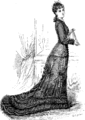
- Jacket and brim costume of 1878 features a long train trimmed with pleated frills and ruching. Matching ruching trims the cuffs of the sleeves.
- Court gown of 1876 features a train, long white gloves and the three white ostrich feathers representing the Prince of Wales plumes in the hair.
- Hunting costume is fabricated light-green wool, Scotland, c. 1878.
Extravaganza gallery [edit]
-

1 – belatedly 1870s
-

2 – 1871
-

iii – 1876
-

iv – 1878
- Cartoon "Veto" by George du Maurier from Punch, satirizing the tight clothes styles of the late 1870s.
- An extreme class contrast: "Young lady of fashion, 1871" vs. "London Dairywoman".
- From the Danish Punch, satirizing the full general fashion in 1876
- Cartoon past George du Maurier from Dial, May 25, 1878, satirizing both impractical women's fashions and men's formal military uniforms.
Men's way [edit]

Paris mode of 1878 features a coat with a contrasting collar, a waistcoat decorated with a watch chain, broad ascot necktie, square-toed shoes, and a pinnacle hat.

Canadian legislator John Charles Rykert wears a narrow ribbon necktie and a collarless waistcoat. His glaze has wide lapels. 1873.
Innovations in men's fashion of the 1870s included the acceptance of patterned or figured fabrics for shirts and the general replacement of neckties tied in bow knots with the iv-in-paw and later the ascot tie.
Coats and trousers [edit]
Frock coats remained fashionable, only new shorter versions arose, distinguished from the sack coat by a waist seam.[ clarification needed ] Waistcoats (U.Due south. vests) were generally cutting directly beyond the front and had collars and lapels, but collarless waistcoats were also worn.
3-piece suits consisting of a loftier-buttoned sack coat with matching waistcoat and trousers, called ditto suits or (Britain) lounge suits, grew in popularity; the sack coat might be cutaway so that only the acme button could exist fastened.
The cutaway morning glaze was still worn for informal solar day occasions in Europe and major cities elsewhere. Frock coats were required for more formal daytime clothes. Formal evening clothes remained a night tail coat and trousers. The coat now fastened lower on the chest and had wider lapels. A new fashion was a night rather than white waistcoat. Evening clothing was worn with a white bow tie and a shirt with the new winged collar.
Topcoats had wide lapels and deep cuffs, and often featured contrasting velvet collars. Furlined full-length overcoats were luxury items in the coldest climates.
Total-length trousers were worn for most occasions; tweed or woollen breeches were worn for hunting and hiking.
In 1873, Levi Strauss and Jacob Davis began to sell the original copper-riveted blue jeans in San Francisco. These became popular with the local multitude of gold seekers, who wanted stiff clothing with durable pockets.[seven]
Shirts and neckties [edit]
The points of high upstanding shirt collars were increasingly pressed into "wings".
Tie fashions included the four-in-paw and, toward the end of the decade, the ascot tie, a tie with wide wings and a narrow neckband, fastened with a jewel or stickpin. Ties knotted in a bow remained a bourgeois fashion, and a white bowtie was required with formal evening article of clothing.
A narrow ribbon tie was an alternative for tropical climates, and was increasingly worn elsewhere, especially in the Americas.
Accessories [edit]
Top hats remained a requirement for upper grade formal wear; bowlers and soft felt hats in a variety of shapes were worn for more than coincidental occasions, and flat straw boaters were worn for yachting and other nautical pastimes.
Style gallery 1870–1875 [edit]
-

ane – 1870s
-
2 – 1870s
-
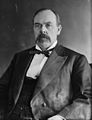
3 – 1870s
-

4 – 1872
-

5 – 1872
-

6 – 1875
- 1870s photo of President Rutherford B. Hayes. His coat and shawl-collared vest or waistcoat have covered buttons. Notation functional buttonholes all the way up his coat lapel.
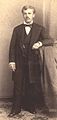
- Three-piece suit with frock glaze, 1870s.
- Oliver Hazard Perry Morton wears a narrow string tie, 1870s.
- Gentleman in a railway carriage wears a dust-colored coat, trousers, and neckband-less waistcoat with a dark red necktie. He wears a fur-lined overcoat and tan gloves. Britain, 1872.
- Plate from The Gazette of Fashion shows a fur-lined overcoat (left) and double-breasted topcoat (correct) with braid trim and decorative topstitching, 1872. Checked trousers were quite stylish.
- Lensman Mathew Brady wears a glaze with braid trim on the neckband and lapels over a matching waistcoat. His turned-down collar is worn over a four-in-mitt necktie. 1875.
Way gallery 1875–1879 [edit]
-

1 - 1875–1880
-

2 – 1876
-

3 – 1879
-
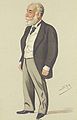
4 – 1879
-
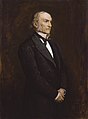
5 – 1879
- 2-piece lounge suit of tartan wool twill buttons high in front end. English lounge suits were typically worn with bowler hats. 1875-80, England, Los Angeles County Museum of Art, M.2010.33.9a-b.
- Major-Full general The Hon. James MacDonald is drawn by James Tissot in a slightly fitted, double-breasted topcoat with a diagonally positioned breast pocket and a contrasting collar. His shirt collar is pressed into flat wings and is worn with a wide, dark tie. He wears a top hat and gloves. 1876.
- 1879 photo of American constable Bat Masterson wearing a three-piece suit and a bowler chapeau. His cutaway sack coat has a high front closure and is worn buttoned only at the acme, over a vest or waistcoat cut straight across at the waist and decorated with a prominent picket concatenation.
- Vanity Off-white sketch of 1879 shows Sir Albert Abdallah David Sassoon in "morning dress" (formal daywear): grayness trousers, dark cutaway coat, white waistcoat, wing-collared shirt and night necktie.
- British statesman William Gladstone wears conservative vesture; his alpine neckband is still upstanding, and he wears his tie in a bow knot. 1879.
Necktie gallery [edit]


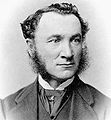


1873 portraits of members of the Legislative Assembly of Ontario illustrate the diversity of fashionable neckwear (and facial pilus).
Children'due south fashion [edit]
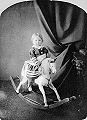
Infants connected to exist dressed in flowing gowns, a fashion that connected into the early 20th century. Gender dress changes often did not occur until a child was 5 or six; withal, in the subsequently decades gender dress came much sooner. Girls' ages could be depicted often based on the length of their skirt. Equally the girls got older, they wore longer skirts. A iv-year-onetime would wear her skirt slightly to a higher place knee length; 10 to twelve at mid-knee joint; twelve to fifteen varied from below the knee to mid-dogie; and by 16 or seventeen, a girl'southward dress would be only in a higher place ankle length. The age of a boy could often be decided based on the length and type of trouser or how similar the attire was to that of a human being'due south. Boys often dressed like to adult males, as they too wore blazers and Norfolk jackets.
Much influence on the styles of children's dress came from artist Kate Greenaway, an illustrator of children's books. She strongly influenced styles of young girls' clothes, as she often showed girls dressed in empire styles in her books. The thought of children's clothes being taken from books is too constitute is styles such as the Little Lord Fauntleroy suit which was worn past the hero of a children'due south book published in 1885-86.
-

1870 way plate
-

Summer apparel with sash, 1872–73
-
Meet as well [edit]
- Victorian way
- Corset controversy
- Dolly Varden (costume)
- Artistic Apparel movement
Notes [edit]
- ^ For commentary on the apparel in this portrait, see Jane Ashelford, The Art of Dress
- ^ At Dwelling house at Tea Time: Tea Gowns for Distinction and Comfort, 1870-1920, Kent Land University Museum Showroom, April to August 1997, Anne Bissonnette, Curator
- ^ The Girls in Green: Women'due south Seaside Wearing apparel in England, 1850–1900, Deirdre Potato, The Costume Club, Vol. xl, 2006
- ^ Takeda and spilker (2010), p. 96
- ^ Takeda and Spilker (2010), p. 99.
- ^ Bigelow, Marybelle S. (1970). Way in History: Western Dress, Prehistoric to Nowadays . Minneapolis, Minnesota: Burgess Publishing Visitor. pp. 271.
- ^ http://world wide web.uri.edu/personal/svon6141/history.htm Archived 2011-07-20 at the Wayback Machine The History of Jeans
References [edit]
- Arnold, Janet: Patterns of Fashion ii: Englishwomen's Dresses and Their Construction C.1860–1940, Wace 1966, Macmillan 1972. Revised metric edition, Drama Books 1977. ISBN 0-89676-027-8
- Ashelford, Jane: The Art of Clothes: Clothing and Society 1500–1914, Abrams, 1996. ISBN 0-8109-6317-5
- Goldthorpe, Caroline: From Queen to Empress: Victorian Dress 1837–1877, Metropolitan Museum of Art, New York, 1988, ISBN 0-87099-535-9 (full text bachelor online from the Metropolitan Museum of Fine art Digital Collections)
- Martin, Linda: "The Way We Wore, Way Illustrations of Children'due south Wear 1870- 1970", Charles Scribner'south Sons, New York, 1978, ISBN 0-684-15655-5
- Payne, Blanche: History of Costume from the Aboriginal Egyptians to the Twentieth Century, Harper & Row, 1965. No ISBN for this edition; ASIN B0006BMNFS
- Steele, Valerie: Paris Fashion: A Cultural History, Oxford Academy Press, 1988; ISBN 0-19-504465-vii
- Takeda, Sharon Sadako, and Kaye Durland Spilker, Fashioning Fashion: European Wearing apparel in Detail, 1700 - 1915, LACMA/Prestel USA (2010), ISBN 978-iii-7913-5062-2
- Tortora, Phyllis. Eubank, Keith: "Survey of Historic Costume, A History of Western Dress", Fourth Edition. Fairchild Publications, Inc. 1989; ISBN i-56367-345-2
External links [edit]
- 1870s Manner Plates of men, women, and children'due south fashion from The Metropolitan Museum of Art Libraries
- History of 1870s bustles
- Victorian Women's mode: 1870s
- Victorian Women's Mode, 1850-1900: Hairstyles
- 1870s Men'due south Fashions – c. 1870 Men's Fashion Photos with Annotations
- From Reforming Fashion, 1850-1914: Politics, Wellness, and Art, Ohio State University :
- Reda silk brocade tea gown, c. 1876
- Brown challis tean gown in Liberty of London fabric, c. 1877
- "19th Century Women's Fashion". Fashion, Jewellery & Accessories. Victoria and Albert Museum. Retrieved 2007-12-09 .
- Adult female's dress, 1870s, in the Staten Island Historical Society Online Collections Database
- Girl's dress, 1870s, in the Staten Island Historical Order Online Collections Database
0 Response to "1870 Victorian Ladies Hats Fashion Plate"
Post a Comment